

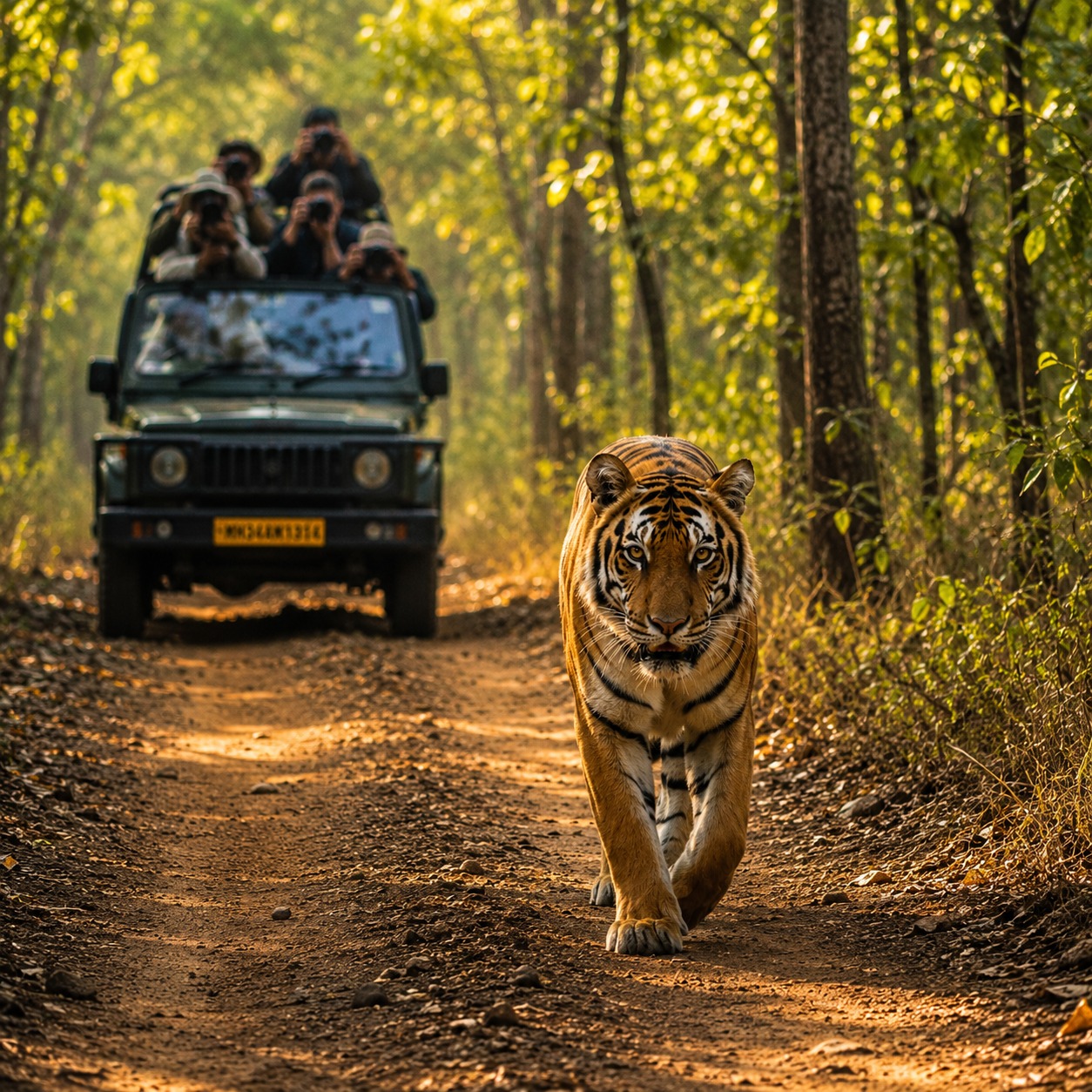
Famous Tigers of Tadoba: Maya, Matkasur, Choti Tara, Sonam & The New Faces of the Jungle
Famous Tigers of Tadoba: Maya, Matkasur, Choti Tara,
Sonam & The New Faces of the Jungle
For many people visiting Tadoba for the first time, the
excitement is not just about spotting a tiger.
It is about spotting that tiger.
The one they’ve seen in photographs.
The one safari guides talk about.
The one whose story has become part of Tadoba’s wildlife history.
Over the years, Tadoba-Andhari Tiger Reserve has become
famous not only for tiger sightings, but also for the personalities and
legacies of some extraordinary tigers and tigresses.

Some became legends because of their bold nature.
Some because of their dominance.
And some because generations of cubs carried forward their bloodline across the
forests of Tadoba.
If you spend enough time in Tadoba, you’ll realize something
interesting:
Every famous tiger here has a story.
And safari guides still speak about many of them like old
local legends.
Maya — The Queen of Tadoba
If there is one tigress that transformed Tadoba’s popularity
across India, it was Maya.
For years, Maya became the face of Tadoba wildlife tourism.
She was known for her calm confidence, frequent sightings, and unforgettable
road walks in front of safari vehicles.
Unlike shy tigers that disappear quickly into the forest,
Maya often appeared relaxed around safari routes, which made her extremely
popular among photographers and first-time visitors.
She ruled parts of the Moharli zone and became one of the
most photographed tigresses in India.
Many travelers visited Tadoba hoping for one thing:
“A Maya sighting.”
Even today, guides and naturalists still talk about her
presence with enormous respect.
Matkasur — The Legendary Male of Tadoba
Massive, powerful, and fearless — Matkasur was one of
Tadoba’s most iconic male tigers.
He earned legendary status because of:
- His
huge size
- Dominant
personality
- Strong
territory control
Matkasur ruled large parts of Tadoba and was considered one
of the strongest males of his time.
His genetics still continue through many younger tigers seen
today.
In fact, several famous Tadoba tigers belong to his lineage,
including Chota Matka.
Among safari guides, Matkasur is often remembered as:
“One of the true kings of Tadoba.”
Choti Tara — The Bold Tigress
Choti Tara is another legendary name in Tadoba.
Born around 2009, she became famous for her bold and
fearless behavior inside the reserve. She was known for confidently moving
through safari tracks and defending her territory strongly.
Her territory often overlapped with other dominant
tigresses, including Maya, and stories of territorial conflicts between them
became well known among guides and wildlife enthusiasts.
What makes Choti Tara even more important in Tadoba’s
history is her bloodline.
She is the mother of:
- Roma
- Bijlee
- Chota
Matka
Many of today’s popular tiger sightings in Tadoba are
directly connected to her lineage.
Even as she grew older, Choti Tara continued to remain an
important tigress in the forest ecosystem.

Sonam — The Guardian of Telia
Sonam is one of the most recognized tigresses of the Telia
region in Tadoba.
She belongs to the famous “Telia sisters” lineage and became
dominant after defending and controlling the Telia landscape from her siblings.
Safari guides often describe Sonam as:
- Protective
- Powerful
- Extremely
territorial
She became popular because of her regular sightings near
Telia Lake and nearby water bodies.
Sonam is also closely connected to the legendary Waghdoh
(often called Big Daddy), one of Tadoba’s most famous male tigers.
Over the years, Sonam successfully raised cubs and continued
her family line in the reserve. Even today, many visitors ask specifically
about Sonam sightings during safaris.
Wagdoh (Big Daddy) — The Legend Beyond Tadoba
No conversation about Tadoba tigers feels complete without
mentioning Wagdoh.
Also known as “Big Daddy,” Wagdoh became famous worldwide
after appearing in wildlife documentaries and photography tours.
He was known for:
- Massive
body size
- Scarred
face
- Dominant
presence
- Extraordinary
territorial strength
Wagdoh fathered several cubs and contributed significantly
to Tadoba’s tiger population.
For many wildlife photographers, spotting Wagdoh was once
considered a dream sighting.
Even after his prime years, his legacy remains deeply
connected to Tadoba’s identity.
Chota Matka — The New-Age Dominant Male
Chota Matka, son of Matkasur and Choti Tara, became one of
the strongest male tigers in Tadoba’s buffer regions.
He inherited:
- Huge
body size
- Dominant
behavior
- Strong
territorial control
Chota Matka became especially famous around Navegaon,
Nimdhela, and buffer landscapes where he ruled for years.
Guides often called him:
“The King of Tadoba Buffer.”
Recently, however, Chota Matka made headlines after
suffering injuries during territorial fights, leading forest officials to
temporarily rescue and treat him. His absence has opened up competition among
younger males trying to claim his territory.
Mowgli — The Massive Male from Kolsa
Mowgli is another well-known male tiger from the Kolsa
landscape.
He became famous because of:
- His
massive head and frame
- Powerful
gaur hunting ability
- Strong
presence in deeper forest regions
Unlike some highly visible tigers around tourism routes,
Mowgli built his reputation among experienced safari travelers and wildlife
photographers.
He is often associated with the wilder, less commercial side
of Tadoba.
The New Faces of Tadoba
Tadoba’s tiger stories continue to evolve every year.
Today, younger tigers and tigresses like:
- Roma
- Bijlee
- Collarwali
- Choti
Madhu
- Virbhadra
- Bali
are increasingly becoming popular among guides and safari
travelers.
As older legends age or disappear, new territories are
constantly forming inside the reserve.
That is what makes Tadoba so fascinating:
The jungle story never stays the same.
Why Travelers Become Emotionally Attached to Tadoba
Tigers
At first, many visitors come to Tadoba simply hoping to see
a tiger.

But after a few safaris, something changes.
You start recognizing individual personalities.
You remember territories.
You hear stories from guides.
You begin understanding lineages and behavior.
And slowly, these tigers stop feeling like “animals in a
forest.”
They begin feeling like characters in an ongoing jungle
story.
That emotional connection is one of the biggest reasons why
so many people return to Tadoba again and again.
Korners of India
9899893823